










































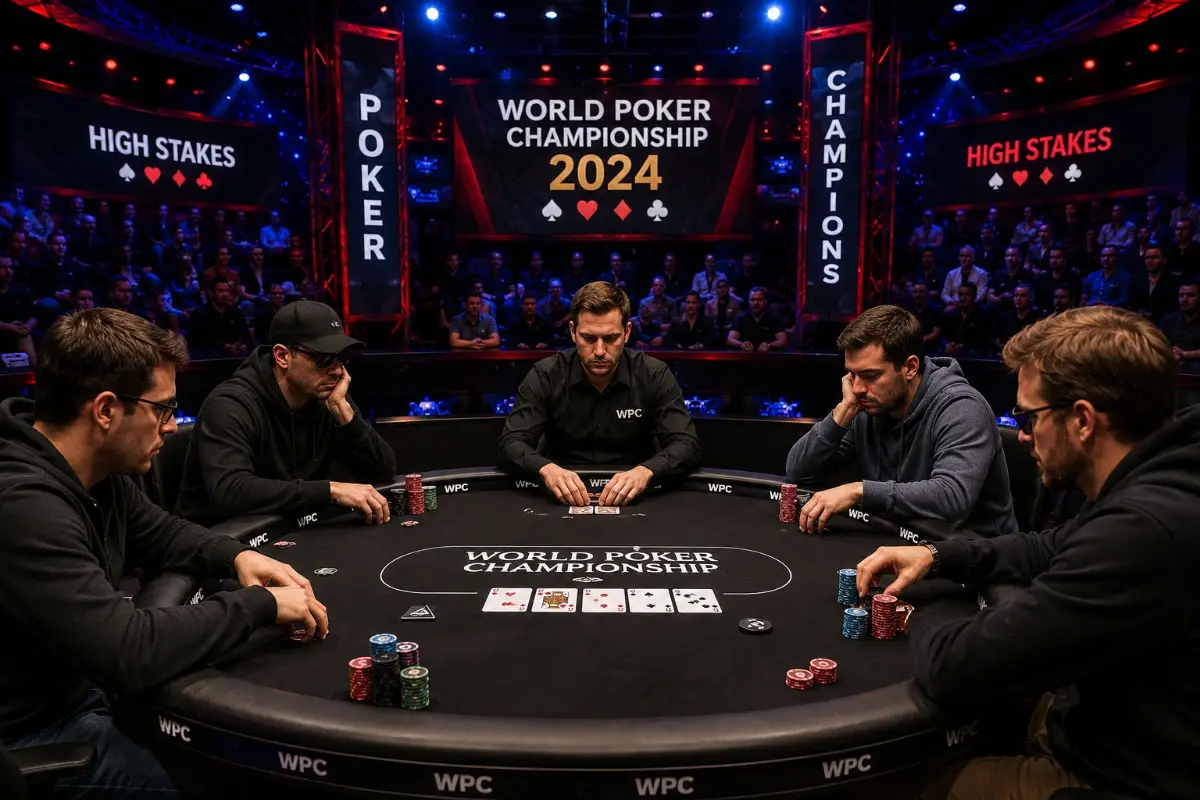
Major Poker Tournaments to Watch: Pros Prepare for High-Stakes Action
Major poker tournaments represent the ultimate test of skill, discipline, strategy, and emotional control. From prestigious live events to major championship series, these competitions bring together experienced professionals, ambitious newcomers, and some of the biggest prize pools in the game.
For poker fans, major tournaments offer thrilling action and memorable moments. For professional players, they demand months of preparation and an exceptional ability to make strong decisions under pressure.
The most important tournaments are not simply about winning a single hand. Players must navigate changing stack sizes, evolving table dynamics, structured blind increases, opponents with different strategies, and the psychological demands of long sessions. That combination makes major poker tournaments fascinating to watch and exceptionally challenging to master.




This guide explores the major poker tournaments worth following, how professionals prepare for high-stakes action, what makes these events special, and how viewers can better understand the decisions taking place at the table.
Why Major Poker Tournaments Attract Global Attention
Major poker tournaments combine competition, strategy, drama, and unpredictability in a unique format.
Unlike a casual cash game, tournament players compete for escalating prizes while their tournament lives are finite. Losing all their chips means elimination. This creates strategic pressure that changes throughout an event.
Large tournaments also attract elite fields. Professionals can face opponents with extensive experience in live tournament strategy, online competition, mathematical analysis, and high-pressure decision-making.
For spectators, that creates an opportunity to see advanced poker strategy in action.
The strongest tournaments also feature compelling stories. An established professional may be attempting another championship, while an emerging player may be chasing a breakthrough victory. A relatively unknown competitor can suddenly reach a final table and compete against players with years of experience.
That mixture of expertise and uncertainty is one reason major poker tournaments continue to command attention.
Major Poker Tournaments Worth Watching
Several tournament series and championship events have become landmarks in the international poker calendar.
World Series of Poker
The World Series of Poker, commonly known as the WSOP, is among the most recognizable names in competitive poker.
Its schedule traditionally includes a broad range of events, including different buy-in levels, game variants, and tournament structures. The Main Event remains the centerpiece for many fans because of its enormous prestige and history.
Professionals prepare carefully for the WSOP because a tournament schedule can require sustained concentration across many days.
The variety of events also makes the series particularly attractive to viewers. Some competitions emphasize traditional no-limit hold’em, while others showcase formats requiring specialized knowledge.
For anyone following major poker tournaments, the WSOP is an essential event to understand.
World Poker Tour Events
The World Poker Tour has played a major role in popularizing televised tournament poker.
WPT events have historically brought professional competition to major destinations and featured recognizable players competing for substantial prizes and prestigious titles.
The televised nature of many WPT events helps spectators understand the strategic side of poker. Viewers can observe betting patterns, stack sizes, positional considerations, and difficult decisions that are not always obvious from simply watching the cards.
European Poker Tour
The European Poker Tour, or EPT, is another major destination for elite tournament players.
EPT stops have attracted international fields and developed a strong reputation for competitive poker. The tour’s international character adds another dimension because players encounter opponents with different backgrounds and strategic approaches.
For fans interested in major poker tournaments, EPT events provide an excellent look at high-level competition outside the traditional American tournament circuit.
High-Roller Championships
High-roller tournaments occupy a special place in professional poker.
These events generally involve significantly larger buy-ins and therefore attract many experienced professionals and financially prepared participants. Because tournament costs can be substantial, responsible bankroll management and financial discipline are particularly important.
High-roller fields can be relatively small compared with huge open-field tournaments, but the concentration of elite talent can make every decision intensely important.
How Professionals Prepare for High-Stakes Action
Professional preparation extends far beyond simply playing more poker.
Elite tournament players often study previous hands, review strategic situations, examine opponent tendencies, and work on maintaining concentration during long sessions.
Strategic Preparation
A strong player understands that tournament strategy changes according to circumstances.
Early in an event, stacks may be relatively deep, creating opportunities for more post-flop decision-making. As blinds and antes increase, the pressure on shorter stacks becomes greater.
Near a final table, payout considerations can also influence optimal decisions.
Professionals therefore prepare for different stages rather than relying on one fixed strategy.
Mathematical Understanding
Poker contains substantial mathematical reasoning.
Players regularly evaluate probabilities, expected value, pot odds, implied odds, and the likely ranges of opponents. They do not need to calculate every possibility manually, but strong mathematical intuition helps them make better decisions.
Probability theory is particularly useful because poker outcomes contain considerable short-term variance. A strategically sound decision can lose in an individual hand, while a poor decision can occasionally succeed.
Understanding that distinction helps professionals remain disciplined.
Mental Preparation
High-level tournament poker can involve hours of concentration.
Players may experience fatigue, disappointment, excitement, and pressure while still needing to make rational decisions. Mental preparation therefore plays an important role.
Research in cognitive psychology consistently recognizes the importance of factors such as attention, fatigue, and emotional regulation in decision-making. In practical terms, tournament professionals benefit from routines that support sustained concentration, adequate rest, and controlled emotional responses.
The goal is not to eliminate emotion. It is to prevent temporary emotions from controlling important decisions.
The Importance of Tournament Bankroll Discipline
High-stakes poker requires financial responsibility.
Even excellent players can experience losing periods because tournament results are affected by variance. A player can make correct decisions repeatedly and still fail to cash.
Professional bankroll management helps separate poker decisions from immediate financial pressure.
Players should only participate at stakes appropriate to their available funds and circumstances. Recreational participants should never treat tournament poker as guaranteed income.
This is especially important when following major poker tournaments, because televised events can make enormous prize pools appear deceptively accessible.
Prize money is real, but reaching the final stages requires exceptional performance, favorable circumstances, and significant variance.
Understanding Tournament Variance
Variance is one of the most important concepts in poker.
A tournament winner does not necessarily represent the strongest player in every individual hand or even every stage of an event. Tournament outcomes involve probability and changing circumstances.
A professional’s long-term objective is therefore to maximize the quality of decisions rather than obsess over individual results.
This principle helps explain why professional players can remain confident after losing with a statistically strong hand.
They evaluate the decision rather than judging themselves solely by the outcome.
For spectators, understanding variance makes major poker tournaments even more interesting. A dramatic elimination does not automatically mean someone played badly.
What Makes a Final Table So Exciting?
The final table is where tournament pressure reaches its peak.
Only a small group of players remain, and every decision can have enormous consequences. Stack sizes become increasingly important, while payout jumps can affect strategic choices.
Players may become more aggressive when opponents are trying to protect their positions. Others may exploit short stacks or apply pressure to medium stacks.
The combination of money, prestige, fatigue, and competition creates an extraordinary environment.
For viewers, the final table also provides the clearest opportunity to observe how professionals adapt.
A player who dominates early may need to change strategy completely when the table becomes shorter.
Technology and Modern Poker Preparation
Technology has transformed how professionals study the game.
Players can use databases, hand histories, statistical tools, training platforms, and simulation software to examine strategic situations. Modern analysis can help competitors identify weaknesses and understand complex decisions.
However, technology does not replace experience.
A tournament table is dynamic. Opponents may deviate from theoretically optimal strategies, and unexpected situations constantly arise.
The best professionals combine analytical preparation with practical judgment.
This balance between technology and human decision-making is one of the defining features of modern major poker tournaments.
How Viewers Can Follow Major Poker Tournaments More Intelligently
Watching poker becomes much more rewarding when spectators look beyond the cards.
Instead of asking only, “Who has the best hand?” consider several additional questions:
- What are the players’ stack sizes?
- What position is each player in?
- How large are the blinds and antes?
- What hands might an opponent reasonably hold?
- Why did the player choose that bet size?
- How does the tournament stage influence the decision?
- Is the player protecting a stack or applying pressure?
- How might the payout structure affect risk?
These questions reveal the deeper strategy behind every major decision.
The Role of Responsible Participation
Poker should be approached as entertainment and competitive strategy, not as a guaranteed way to make money.
Players should establish limits before participating, understand the rules, and avoid wagering money they cannot afford to lose. Responsible gambling practices are especially important when tournament coverage highlights large prizes.
For recreational players, watching professionals can be an educational experience without requiring participation in high-stakes games.
The excitement of major poker tournaments comes from competition, preparation, and uncertainty—not from assuming that a big prize is easy to achieve.
What Separates Elite Tournament Players?
The strongest professionals usually demonstrate several qualities simultaneously.
Discipline: They follow their strategic plans instead of making emotional decisions.
Adaptability: They change their approach as stack sizes, opponents, and tournament conditions evolve.
Patience: They understand that not every hand deserves aggressive action.
Mathematical reasoning: They use probability and expected value to guide decisions.
Emotional control: They recover from setbacks without allowing frustration to influence subsequent decisions.
Endurance: They maintain focus through long tournament sessions.
These qualities help explain why professional poker is considerably more complex than simply knowing which cards are strong.
The Future of Major Poker Tournaments
Competitive poker continues to evolve.
Online qualification systems can introduce new players to major events, while streaming technology allows audiences around the world to follow tournament action. Advanced statistical analysis and training technology are also changing how professionals prepare.
At the same time, the fundamental appeal remains unchanged.
Two players can receive different cards, make different decisions, and experience completely different outcomes. Skill matters enormously over time, but uncertainty remains present in every tournament.
That tension creates the excitement that has sustained poker’s popularity for decades.
Frequently Asked Questions
What is considered a major poker tournament?
Major poker tournaments generally include prestigious international championship events and large tournament series featuring strong professional fields, substantial prize pools, and established reputations.
Which poker tournament is the most famous?
The WSOP Main Event is widely regarded as one of the most famous poker tournaments in the world because of its history, prestige, international participation, and substantial prize pool.
How do professional poker players prepare for tournaments?
Professionals typically prepare through strategic study, hand analysis, mathematical training, opponent research, physical preparation, and routines designed to maintain concentration.
Why is tournament poker difficult?
Tournament poker combines strategic decision-making with changing stack sizes, increasing blinds, elimination risk, payout structures, psychological pressure, and substantial variance.
Does skill or luck matter more in poker tournaments?
Both matter. Individual tournament outcomes can be heavily influenced by short-term variance, while skill becomes increasingly meaningful across a large number of decisions and tournaments.
What should beginners watch for during major poker tournaments?
Beginners should focus on position, stack sizes, bet sizing, player tendencies, tournament stages, and the reasoning behind major decisions rather than concentrating only on the cards shown.
Final Thoughts
Major Poker Tournaments to Watch: Pros Prepare for High-Stakes Action is more than a story about huge prizes and dramatic hands. These events showcase strategic thinking, mathematical reasoning, discipline, adaptability, and psychological resilience at the highest level.