













































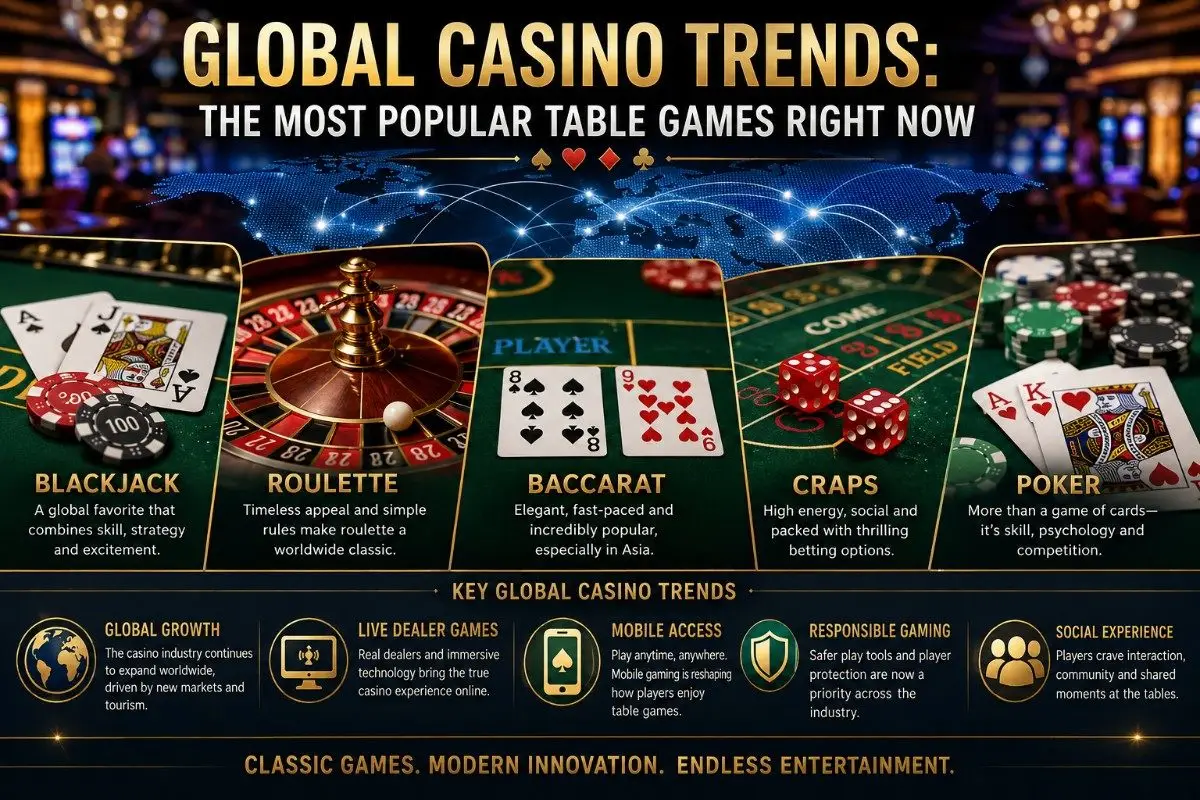
Global Casino Trends: The Most Popular Table Games Right Now
Casino table games have a remarkable ability to remain timeless while continually evolving. From the elegant baccarat tables of Macau to the energetic roulette floors of Las Vegas and the increasingly sophisticated live-dealer experiences available online, familiar games continue to attract players around the world.
But what is driving today’s Global Casino Trends: The Most Popular Table Games Right Now?
The answer is more nuanced than simply naming a single worldwide winner. Casino markets differ by country, regulation, culture and player preference. Even so, several table games consistently stand out because they combine recognizable rules, social interaction, fast-paced play and strong traditions.




This guide explores those games, explains why they remain popular and separates genuine casino trends from exaggerated claims.
Most importantly, popularity should never be confused with profitability. Casino games involve risk, and no table game guarantees a win. The responsible approach is to understand the rules, know the costs, set limits and treat gambling as entertainment.
What Are the Biggest Global Casino Trends Today?
The modern casino landscape is becoming more connected, accessible and technology-driven.
In the United States, the commercial gaming market reached a record $78.72 billion in gross gaming revenue in 2025, according to the American Gaming Association. Traditional casino gaming, online gaming and sports betting all contributed to the broader market.
The latest AGA revenue data also shows continued strength in traditional casinos. In the second quarter of 2026, U.S. traditional casino gaming generated $13.43 billion, with table-game revenue increasing 3.2% year over year.
These figures do not establish one universal global ranking of individual table games. They do, however, demonstrate that traditional casino entertainment remains highly relevant alongside digital alternatives.
Several trends are particularly important:
- Classic games remain powerful.
- Live-dealer casino experiences are becoming more sophisticated.
- Mobile access is changing how people discover casino games.
- Players have greater access to game information and rules.
- Regulation and responsible-gambling tools are becoming increasingly important.
- Authentic table-game experiences continue to appeal to social players.
Together, these developments help explain why blackjack, roulette, baccarat, craps and poker continue to command attention.
1. Blackjack Remains a Global Favorite
Few casino games are as recognizable as blackjack.
The appeal is easy to understand. The objective is straightforward: beat the dealer without exceeding 21. Unlike purely mechanical games, blackjack also gives players decisions to make, such as whether to hit, stand, double down or split.
That sense of participation is a major part of its enduring appeal.
Blackjack also benefits from its accessibility. Beginners can learn the basic rules quickly, while experienced players may explore probability, strategy charts and different rule variations.
However, an important distinction matters: having decisions to make does not mean a player can guarantee a profitable outcome.
The exact mathematical advantage depends on the rules, payouts and strategy used. Players should therefore examine the specific table rules instead of assuming that every blackjack game is identical.
That combination of simplicity, decision-making and tradition makes blackjack one of the defining games in Global Casino Trends: The Most Popular Table Games Right Now.
2. Roulette Delivers Instant Recognition and Excitement
Roulette has perhaps the strongest visual identity of any classic casino game.
The spinning wheel, numbered layout and anticipation surrounding the ball create a distinctive experience that works equally well in physical casinos and digital live-dealer environments.
Players can choose from numerous wager types, including individual numbers, groups of numbers, colors and other combinations.
That variety is one reason roulette remains so accessible. A newcomer can understand the basic concept almost immediately, while experienced players may prefer particular betting formats.
Yet roulette is also an excellent example of why casino knowledge should include probability.
Previous spins do not make a particular future result “due.” Independent outcomes remain independent. The Responsible Gambling Council specifically identifies this belief as the gambler’s fallacy: previous results do not alter the probability of the next random outcome.
In other words, a streak can be interesting, but it does not create a reliable prediction.
That simple fact is central to understanding roulette—and responsible casino play generally.
3. Baccarat Continues Its Remarkable Rise
Baccarat has long been associated with luxury casino environments, but its appeal extends far beyond high-end gaming floors.
The basic structure is comparatively simple. Players generally wager on the Player hand, Banker hand or a tie, with cards dealt according to established rules.
Unlike blackjack, players do not normally make decisions about how individual cards are played. This simplicity can make baccarat particularly attractive to people who want an elegant, fast-moving table game without complicated decision trees.
Baccarat has also benefited from international casino growth and digital live-dealer formats.
Its cultural importance is especially visible in Asian casino markets, where baccarat has historically been a major casino game. However, the precise popularity of baccarat compared with blackjack or roulette varies considerably between jurisdictions.
That regional variation is an important part of Global Casino Trends: The Most Popular Table Games Right Now. There is no single casino culture.
Different markets create different favorites.
4. Craps Brings Energy to the Casino Floor
Craps offers something that many other table games struggle to reproduce: a highly social atmosphere.
Players gather around the same dice table, react to rolls and often celebrate together. The game’s vocabulary and betting structure can initially seem intimidating, but the fundamental idea—wagering on outcomes involving dice—is easy to understand.
For many casino visitors, craps is as much about atmosphere as mathematics.
The table can become one of the liveliest areas on a casino floor, particularly when several players participate simultaneously.
As with other casino games, however, enthusiasm should not be mistaken for an advantage. Dice outcomes are random, and betting systems cannot remove the underlying house advantage.
The Responsible Gambling Council emphasizes that gambling outcomes are unpredictable and that previous outcomes do not control future results.
5. Poker Offers a Different Kind of Competition
Poker deserves special attention because it does not fit neatly into the same category as games such as roulette or baccarat.
In casino poker rooms, players generally compete against one another rather than directly against the house. The casino typically earns revenue through mechanisms such as a rake or tournament fee.
Poker combines probability, decision-making, psychology and incomplete information. That gives it a distinctive identity within the wider table-game ecosystem.
Its global popularity has also been reinforced by televised tournaments, streaming, online communities and major international events.
However, poker is still not a guaranteed-money activity. Even skilled players experience variance, and short-term results can be unpredictable.
For newcomers, understanding bankroll management, table selection, rules and realistic expectations is far more valuable than believing in a secret winning formula.
Why Classic Table Games Continue to Win Attention
The enduring strength of classic table games is not accidental.
They offer several qualities that modern casino audiences continue to value:
Familiar Rules
Blackjack, roulette and baccarat have recognizable structures. A person can encounter the same basic game in different countries and quickly understand what is happening.
Social Interaction
Physical table games create a shared experience. Players interact with dealers, observe other hands and participate in the atmosphere.
Fast Feedback
Unlike some forms of entertainment, table games produce outcomes quickly. That creates an intense rhythm that many players find engaging.
Choice and Variety
Even within one game, variations can provide different rules, betting options and experiences.
Digital Innovation
Live-dealer technology has brought many traditional table-game experiences to digital platforms. Cameras, professional dealers, real-time interfaces and interactive features can make online play resemble a physical casino more closely.
Nevertheless, technology changes the presentation—not the fundamental mathematics of gambling.
The Rise of Live-Dealer Casino Experiences
One of the most significant developments in modern casino entertainment is the growth of live-dealer formats.
Instead of relying solely on software graphics, live-dealer games connect players to a real dealer through video streaming. Blackjack, roulette and baccarat are particularly suited to this format.
The appeal comes from authenticity.
A physical wheel, cards, dealer and table can create a more familiar environment than a purely digital interface. It also allows players to interact through chat and observe the game as it happens.
But players should still check licensing, game rules, minimum and maximum stakes, available responsible-gambling tools and local legal requirements before participating.
A polished interface is not proof that a gambling service is trustworthy.
Technology Is Changing the Casino Experience—Not the Odds
Modern casino technology can be impressive, but it is important to keep expectations realistic.
Random outcomes remain random.
Research and responsible-gambling organizations consistently emphasize that previous gambling results do not influence future independent outcomes.
Scientific research also supports greater transparency around gambling costs. One experimental study found that providing house-edge information and volatility warnings was associated with reduced gambling expenditure, although the researchers noted that the effects were small and that information alone is not sufficient as a complete public-health solution.
That is why trustworthy casino content should explain probabilities and risks instead of promising “winning systems.”
Responsible Gambling Is Now Part of the Modern Casino Experience
A genuinely trustworthy discussion of casino trends cannot ignore gambling-related harm.
The latest Gambling Survey for Great Britain, published by the Gambling Commission in 2026, found that 47% of adults surveyed had participated in some form of gambling during the previous four weeks, falling to 26% when people who only participated in lottery draws were excluded. The survey also found that online gambling participation was 37%.
These figures demonstrate the scale of gambling participation, but they should not be interpreted as evidence that gambling is risk-free.
A safer approach includes:
- Set a spending limit before playing.
- Decide how much time you are comfortable spending.
- Never borrow money to gamble.
- Never treat gambling as an income strategy.
- Do not chase losses.
- Take breaks.
- Avoid gambling when distressed or impaired.
- Use deposit, spending or time-limit tools where available.
- Stop when the entertainment value disappears.
The Responsible Gambling Council recommends setting time and spending budgets and explicitly warns against chasing losses or treating gambling as a way to replace income.
These principles are not obstacles to enjoyment. They are practical safeguards that help keep entertainment within a healthy boundary.
How to Evaluate a Table Game Before Playing
Popularity should never be the only reason to choose a game.
Before playing, consider five questions:
What are the rules?
Understand the basic objective and available bets before putting money at risk.
What is the house edge?
The house edge represents the casino’s mathematical advantage over the long run. It varies according to the game and its rules.
What are the minimum and maximum bets?
Choose stakes that fit comfortably within a predetermined entertainment budget.
Is the casino properly regulated?
Check the relevant gambling authority in your jurisdiction and verify licensing information.
What responsible-gambling tools are available?
Look for practical controls such as deposit limits, time limits, reality checks and self-exclusion options.
These questions transform casino browsing from impulse into informed decision-making.
What the Future Holds for Global Casino Trends
The future of table games will likely combine tradition with increasingly advanced technology.
Classic games are unlikely to disappear. Instead, they are being repackaged through live streaming, mobile interfaces, immersive environments and increasingly personalized digital experiences.
At the same time, regulation and consumer protection are becoming more prominent.
The U.S. gaming market’s continued expansion, combined with stable participation in regulated gambling markets such as Great Britain, suggests that casino entertainment remains an important global industry.
The most successful future experiences will likely be those that balance excitement with transparency.
That means clear rules, visible costs, trustworthy operators, secure technology and accessible responsible-gambling features.
Final Verdict: The Classics Still Have Extraordinary Staying Power
The most interesting conclusion from Global Casino Trends: The Most Popular Table Games Right Now is that innovation has not replaced tradition.
Blackjack continues to attract players through its decision-making. Roulette delivers iconic excitement. Baccarat combines simplicity and elegance. Craps creates an energetic social atmosphere. Poker adds a distinctive competitive dimension.
Meanwhile, live-dealer technology is giving these classic games a powerful new format.
Yet the smartest casino trend is not simply choosing the most popular game. It is becoming a more informed player.
Understand the rules. Know the mathematics. Recognize randomness. Set limits. Choose regulated environments where applicable. And remember that gambling should remain entertainment—not a financial plan.
The casino world is changing quickly, but one principle remains timeless: the best experience is an informed one.
Frequently Asked Questions
What are the most popular casino table games right now?
Blackjack, roulette, baccarat, craps and poker remain among the most recognizable and widely played casino table games internationally. Exact rankings vary significantly by country, casino market and game format, so there is no single authoritative worldwide leaderboard.
Is blackjack still popular in 2026?
Yes. Blackjack remains a major casino table game because it combines simple rules with player decisions and is available in both physical and live-dealer formats. Its popularity does not mean every blackjack table has identical rules or mathematical conditions.
Why is roulette still so popular?
Roulette combines simple rules, strong visual appeal and many betting options. Its wheel-and-ball format is instantly recognizable, making it one of the world’s most iconic casino games.
Is baccarat only for high rollers?
No. Although baccarat has a strong association with luxury casinos, many modern casinos offer different baccarat formats and betting levels. Availability and minimum stakes depend on the specific venue or platform.
Can casino strategies guarantee a win?
No. No betting system can guarantee a casino win. Random outcomes remain unpredictable, while casino games are generally designed with a mathematical house advantage. The Responsible Gambling Council specifically warns against believing that previous results can predict future outcomes.
What is the house edge?
The house edge is the mathematical advantage built into a casino game over the long run. It differs according to the game, rules and sometimes the specific bet. Understanding it helps players make more informed decisions.
Are live-dealer casino games random?
Regulated games are designed to produce outcomes according to their stated rules and mechanisms. In live-dealer games, physical cards, wheels or other game equipment are used, while digital casino games commonly rely on random-number-generation technology. Players should verify the licensing and technical standards applicable in their jurisdiction.
How can I gamble more responsibly?
Set a spending and time limit before playing, never chase losses, avoid borrowing money to gamble and never treat gambling as a source of income. If gambling stops feeling entertaining or begins affecting finances, relationships or everyday responsibilities, take a break and seek appropriate support.
About This Article
This article was prepared as an independent, informational overview of contemporary casino table-game trends. It draws on current regulatory and industry statistics, including publications from the UK Gambling Commission and American Gaming Association, alongside research literature and established responsible-gambling guidance.